
This page tells you how we monitor and manage your performance using Elexon’s Performance Assurance Framework.
On this page
Elexon’s Performance Assurance Framework (PAF)
Elexon’s Performance Assurance Framework (PAF) has two key elements:
- A list (ledger) of identified Settlement Risks
- Performance Assurance Techniques (PATs) that can be applied to help put things right
If you work for a Performance Assurance Party (PAP) in an operational role connected with Settlement, you should make sure you are familiar with the Settlement Risks associated with the processes you operate, and with the PATs you may need to engage with.
What are Settlement Risks?
A Settlement Risk is any point in the Settlement process that might go wrong.
What are the Performance Assurance Techniques (PATs)?
The PATs are a set of specific provisions and processes designed to protect the market and its participants from the impact of Settlement Risk. They are set out in the Balancing and Settlement Code and Procedures.
The techniques are broadly divided into four categories:
- preventative – to support Performance Assurance Parties (PAPs) in making sure they have the right knowledge, systems and processes in place
- incentive – these motivate PAPs to meet their Code obligations and sanction PAPs that consistently fail to do so
- detective – to identify errors in Settlement and gaps and failures in systems and processes
- remedial – to support PAPs to put these right.
More detail on the techniques is available in this Guidance Note:
- Menu of Performance Assurance Techniques (Guidance Note)
What is the Performance Assurance Operating Period (PAOP)?
The PAF operates on an annual cycle from April to March called the Performance Assurance Operating Period (PAOP). The stages of the cycle, as shown in this diagram, are explained below.
Stages of the POAP cycle
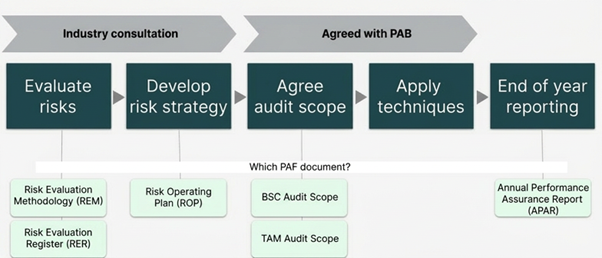
1. Evaluating the risks
Each Autumn, Elexon assesses and sets out the potential impact of each Settlement Risk over the coming PAOP in the Risk Evaluation Register (RER). The RER is sent out to industry for consultation along with the Risk Evaluation Methodology (REM) used to make the assessments. Once Elexon has updated the RER to incorporate any feedback, it is presented to the Performance Assurance Board (PAB) for approval.
2. Developing a risk strategy
Once the RER has been approved, Elexon sets out its strategy to mitigate Settlement Risks over the coming PAOP in the Risk Operating Plan (ROP). This is also sent out to industry for consultation, usually early in the New Year. Again, Elexon updates the ROP to incorporate any feedback, and presents it to the PAB for approval.
3. Agreeing the audit scope
In early Spring, Elexon agrees a Scope of Audit activities for the coming PAOP with the PAB, in line with the broader strategy set out in the ROP.
4. Apply assurance techniques
This is when much of the work takes place to address risks that were set out in the ROP.
Some PATs, such as Performance Assurance Monitoring (PAM), run continuously throughout the year. Some, such as the BSC and Technical Assurance of Metering (TAM) Audits, take place on a rolling annual basis. Others, such as Error and Failure Resolution (EFR) and Trading Disputes, are deployed ad hoc in response to specific events.
5. End of year reporting
From the 2025/2026 PAOP onwards, Elexon will also agree a set of Annual PAM Report Requirements, confirming the Settlement data Elexon will monitor for indicators of Settlement Risk materialising.
Following the end of each PAOP, Elexon is required to produce a series of reports detailing the outcomes of the work it has undertaken.
The Annual Performance Assurance Report (APAR) provides an overview of Performance Assurance activities over the PAOP, together with an assessment of their effectiveness in mitigating the Settlement Risks identified in the RER and ROP.
The BSC and TAM Auditors also produce Annual Audit Reports. These are presented to the PAB and the BSC Panel, together with papers detailing Elexon’s plans to respond to any issues raised.
Elexon will also present findings to the PAB for any Assurance Information Requests (AIRs) or Technical Assurance of Performance Assurance Parties (TAPAP) checks that have taken place.